
You bought another course. Again.
This time it was different, you told yourself. This time you’d actually finish it.
But here’s what usually happens:
Day 1: You’re pumped, taking detailed notes.
.
Day 3: You skip because of a work deadline.
.
.
Day 7: The course collects digital dust while you scroll social media instead.
Two months ago, I faced this exact scenario with Dan Koe’s $175 personal brand course—the same Dan Koe who’s built a 7-figure business teaching people to build authority online. The familiar doubt crept in—how many courses had I bought with good intentions that remained unfinished?
This time, I decided to approach learning differently.
Instead of relying on motivation alone, I applied my approach to ensure completion and building authority.
This time, let’s start with the outcome in mind.
Why Most Course Investments Fail
Here’s the uncomfortable truth: Buying a course creates a dopamine hit that feels like progress. But feeling motivated and taking consistent action are completely different challenges.
Most people approach courses like this:
→ Buy with enthusiasm
→ Start strong for 3-5 days
→ Hit the first obstacle or busy period
→ Promise to “get back to it tomorrow”
→ Never return
The real cost isn’t just the money—it’s the compound effect of unrealized knowledge and the erosion of trust in your own ability to follow through.
Three Concrete Outcomes
One month after completing the course, I can point to three specific transformations:
→ Higher Clarity on Personal Brand Sequence Before: Scattered activities that felt random and disconnected. Now: I understand how newsletters connect to short-form content, why expressing yourself matters, and the systematic sequence for building authority.
→ Concrete Tools and Advanced Methods The journey led me to build Lexicon - my AI writing assistant that captures my voice and handles editorial tasks.
This solved my biggest challenge as a non-native English speaker who struggled with written expression.
I also dove deep into “Great Leads” to strengthen my headline and opening skills, directly building on Dan’s emphasis on powerful beginnings.
→ Improved Confidence in My Authority Path I’m seeing the underlying mechanisms of personal brand building. While there’s still distance to travel, I understand the power of small, consistent steps combined with deepening insights. For my WHAT-learning style, grasping the theory was crucial. The course delivered on both the how and the why.
Let’s travel back in time
Now here’s where it gets interesting—let me show you exactly how I built this system by walking backwards from today to that initial purchase decision.
TODAY - Express about Dan Koe’s course and reflect on the path while writing this Newsletter Edition
Distill a knowledge base
Create a highly distilled knowledge base for Building a Personal Brand. I can use that knowledge base as input for AI assistants to help me with concrete steps. And it is great for a fast recap on main aspects.
As I value sharing to enable your journey too, as loyal readers you also can access this knowledge base here: https://digital-garden.ontheagilepath.net/a-distilled-knowledge-base-for-building-a-personal-brand-base-on-dan-koes-method
I created this knowledge base in 2 steps.
1) With a tiny Python Script I merged all 30 days instructions in one file
2) I asked Google Gemini AI for extracting a knowledge base from that
In “DanKoeFullCourseInstructions.md” you find a 30 days drill down on building a personal brand. I want to turn that into a deep dive knowledge base.
Please remove all the fluff and fillers and create a distilled knowledge base that I can use to write better, to plan and execute a product release. Split by topics. And please come up with own suggestion for how to turn that best into a killer knowledge base.
As Dan Koe is also a master in writing, please in addition analyse the writing style of this 30 days instructions. Add an extra chapter for writing such an eMail newsletter course. I’d like to build something similar in future too.
Add Fast Access points
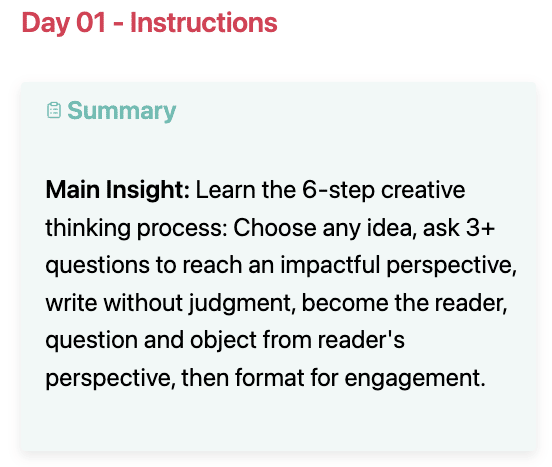
Added a brief AI summary for each day. This helps me to fast scan this notes main insights.
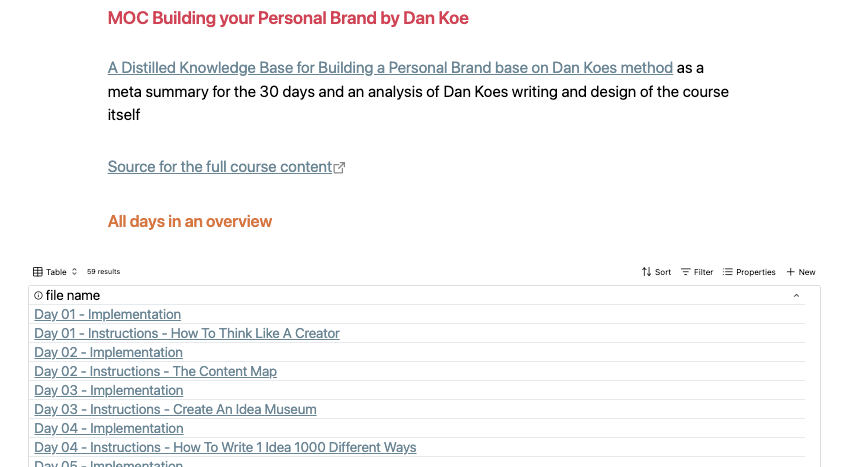
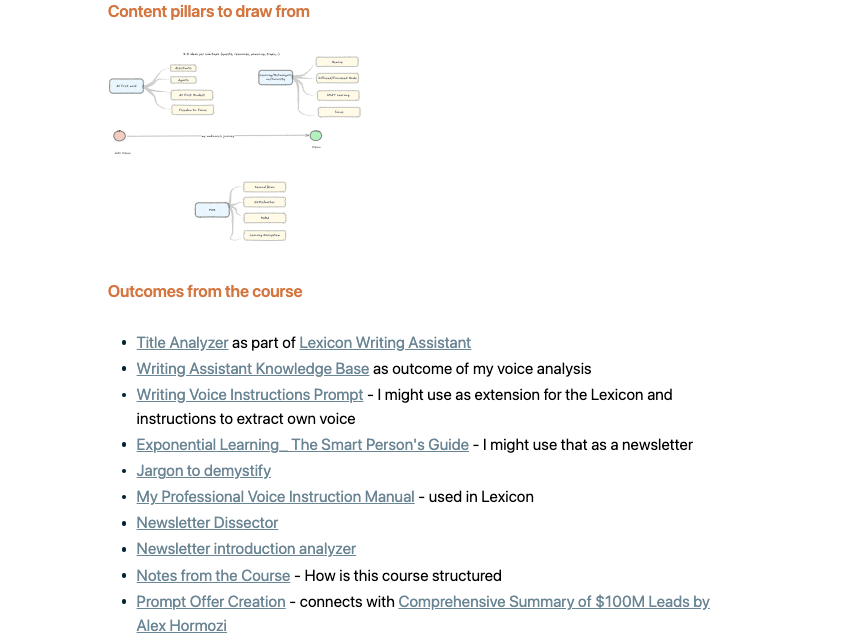
Add a Map of Content for a high level overiew
Embedded all my notes in a Map of Content overview note
Walk through all 30 days
Build a 30 days overview about all course instructions and my implementation notes.
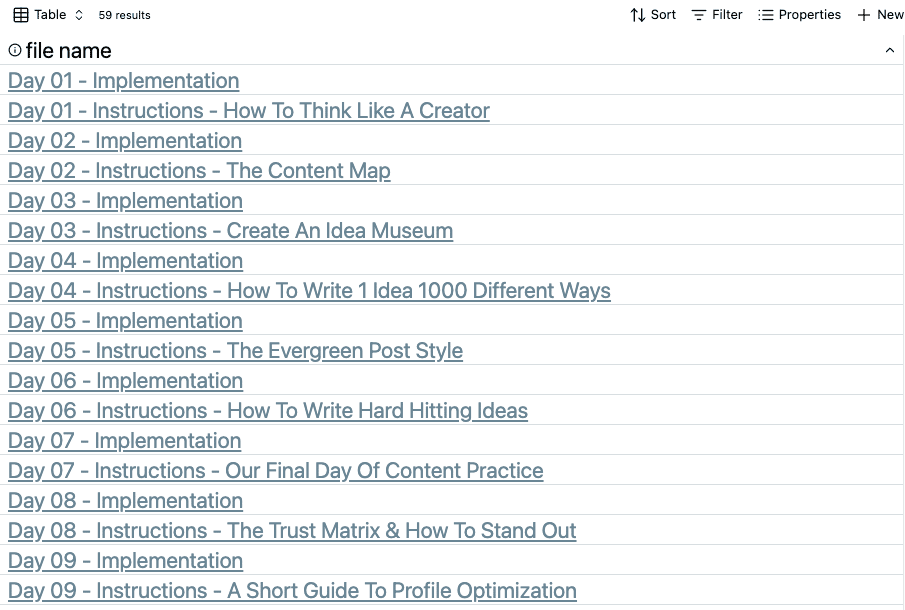
I took each eMail from Dan and made a new note from it. I use Obsidian for making notes and growing my knowledge.
While reading through, I added my thoughts and material that was references. In parallel I took an implementation note for each day. In that note I executed concrete exercises. Went deep with my thoughts. And tracked my progress.
To get this overview, I used the Obsidian Bases that create this dynamic overview in seconds.
My Implementation Timeline
I made a PACT to work daily on the course for 30 consecutive days. This creates commitment and I started strong.
My actual sequence:
Read and highlight each day’s instructions (10 minutes)
Implement exercises and explore what caught my interest (1-6 hours, depending on depth)
Document everything in my structured note system
Did I do this every single day? No. But the PACT kept nagging me, leading to productive catch-up sessions where I’d work through 3-5 lessons in sequence.
Not ideal, but far better than abandoning the course entirely.
The Bigger Picture
I’m actively using the outcomes from the course … they’re shaping how I think and make decisions every day. I see these newsletters as a form of high-impact writing, and I hope they bring value to you as well. (I’d love to hear your thoughts if you feel like replying.)
What’s more, I’ve created a solid knowledge base that I can return to anytime. It’s still evolving, but the key is that I can access and use it quickly—without needing to repeat the full 30-day process. My focus now is building on what’s there and, most importantly, applying it.
Your Turn
I’m curious about your experience with longer-form learning investments like courses or programs.
Specifically: What’s one system or approach you’ve developed to ensure you actually implement what you learn, rather than just consuming it?